How to Choose a Good Profile Photo
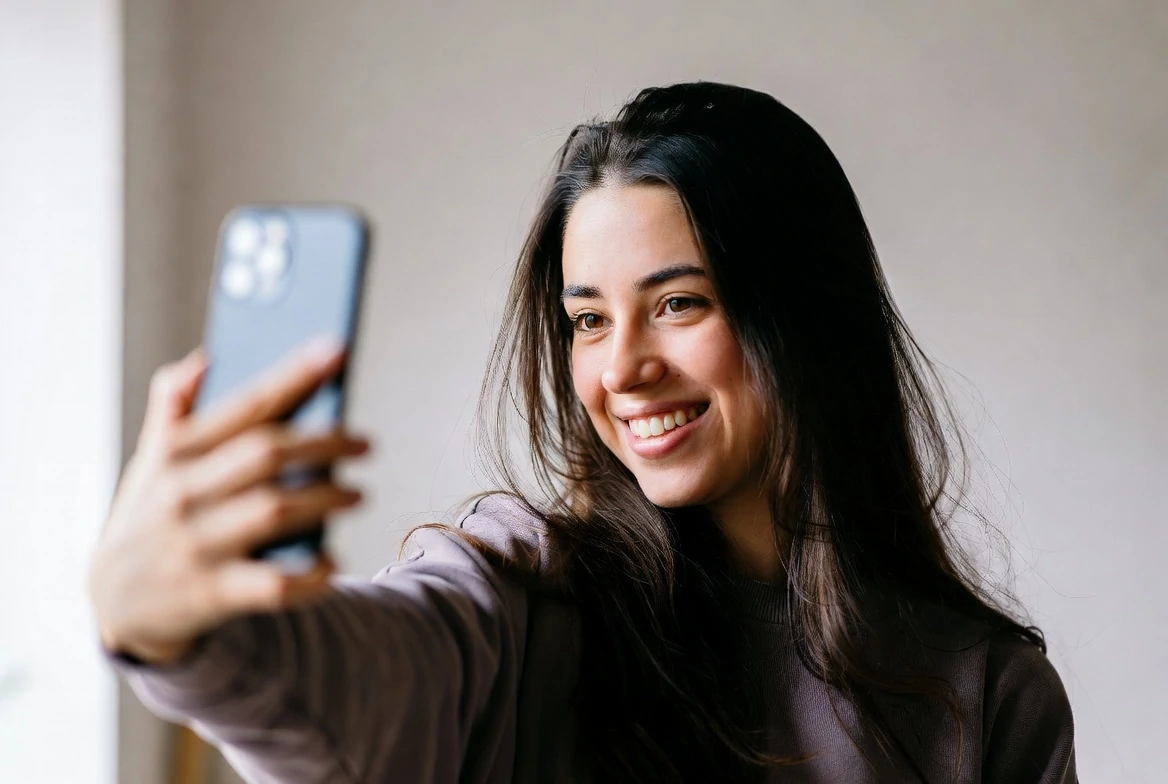
A practical guide to what makes a profile photo work on live video chat: why heavy editing backfires the moment the call connects, what a natural image actually communicates, and how to pick the right one from photos you already have — no studio session required.
A profile photo decides whether someone stays or scrolls past. On live video chat, where the person on the other side is going to see you in real time seconds later, that decision matters even more. Your photo isn't a poster. It's the door into your session.
This is a practical guide. You won't need a studio session or new gear. The point is to understand what a natural image actually communicates, why heavy editing shows up the moment the video call connects, and how to audit the photos you already have to pick the best one.
Why your photo matters more on video chat than on a photo-only app
On a photo-only app, the other person never sees you move. Your still image is the final exam. On live video chat the contract is different: the photo opens the door, and the moment the first call connects, everything else gets revealed.
That difference has a scientific backbone. A Scientific American piece summarizes years of research on facial perception: a still photo doesn't allow accurate personality judgment, but a short video clip does. The smile, the voice, the gestures, the way you tilt your head. Within seconds, the other side has a far more reliable read of your energy than your photo ever could deliver.
The operational takeaway is simple. Your photo has one job: get the other person to open the door. If it overpromises what they'll find on the live call, disappointment lands in the first minute. And the first minute is exactly where connection gets built, not before.
What the science says about edited photos and heavy retouching
A 2025 experimental study published in Frontiers in Communication tested ten variants of dating profiles with nearly four hundred participants. It compared plain selfies, profiles with multiple photos, blurry selfies, selfies with digital beautification, and profiles with video. Two findings matter here.
The first is that sharpness wins every time. The blurry selfie pulled down every profile rating metric, even when the person in the photo was attractive. A sharp, well-lit photo outperforms a digitally polished image laid over a pixelated one.
The second is more nuanced. Digital beautification improved the initial rating of female profiles in the study but didn't change the rating of male profiles. That's what the experiment reports. What the experiment doesn't measure, because it stops at the first impression on a still photo, is what happens next. And next is precisely the live video chat.
That's where the other evidence comes in. Verificat, a fact-checking organization, describes how modern filters reshape features in subtle ways: larger eyes, sharper jawline, uniform skin. These are changes that are hard to spot in an isolated photo, and the person being filtered tends to normalize the filtered version as their new face. The term that circulates in popular literature is selfie dysmorphia.
Reporting from outlets covering Spanish-speaking dating-app markets documents how this pattern translates into real-world use: when a profile looks too retouched, many users simply move on. Heavy retouching gets read as insecurity or as an attempt to mislead, and the outcome is the opposite of what was intended.
What a natural photo communicates (and why it wins live)
A natural photo isn't a careless photo. It's a photo that tells the truth about what the other person is going to find when the video call opens.
Three elements come up across the studies. Soft, frontal lighting. A genuine expression — a real half-smile beats a forced catalog smile. And a background that matches who you are. On backgrounds, there is concrete data: a 2023 PLOS ONE study on video calls found that real rooms with plants or books score higher on trust and authenticity than virtual backgrounds or blank walls. The same applies to your photo. A clean, neutral background works; an overproduced background or a forced set takes away.
BBC Science Focus, in a 2024 piece on first impressions over video calls, adds a technical detail that maps straight onto your photo: framing height. Camera at eye level, not below, not above. And let the light come from in front, not behind. Those two adjustments fix a large share of the profile photos that clearly aren't working.
When those three elements line up, your photo and your video call look like the same person. That coherence is what builds trust from the first second.
How to pick from the photos you already have, no studio required
Before thinking about new photos, audit what you already have. Most people find three or four decent candidates in their own camera roll they had never considered.
The self bias: why your favorite photo usually isn't the best one
A 2017 University of New South Wales study is still the reference here. More than six hundred participants selected profile photos of themselves, and in parallel, strangers selected photos of those same people. The result was sharp: the photos picked by strangers were rated as more flattering, more competent, and more trustworthy than the ones each person had picked of themselves.
The reason is a self-image bias. You pick the photo that matches the mental picture you have of yourself, not the one that best represents you to someone who doesn't know you. The photo where you think you look good is rarely the photo where the other side actually sees you most clearly.
The application is direct. When you get down to your three or four finalists, don't decide alone. Hand them to someone you trust, or better, to someone who doesn't know you well, and let them pick.
A practical checklist for cutting candidates
For a first sweep through your camera roll, automatically rule out:
- Photos that are pixelated, blurry, or underexposed. Sharpness is non-negotiable.
- Group photos where it isn't clear who you are within the first second.
- Photos with obvious filtering: skin too smooth, eyes retouched, features that even you can tell look different.
- Old photos where you don't recognize yourself anymore. If your hair, weight, or style have changed, that photo isn't you.
- Photos with sunglasses or hard shadows that hide your eyes.
From what's left, prioritize three buckets: an honest close-up, a full-body shot, and a photo doing something you enjoy. The three show different angles of the same person, and that is exactly what the other side needs to trust you.
Mistakes that show up on the first video call
There are mistakes a photo can hide and a video call exposes within seconds. Worth anticipating them.
The first is lighting incoherence. If your photo is shot in warm afternoon light and you open the video call under a cold overhead fluorescent, the contrast is brutal. The face changes. The "this wasn't the person in the photo" reaction lands instantly.
The second is an overproduced background. A photo with a clean studio background sets an expectation that a real bedroom rarely meets. You don't need to move house: you just need the background in your photo and the background in your session to play in the same visual league.
The third, and probably the most expensive over time, is the retouching you no longer even notice. Your filtered face has become your mental reference, but live you can't apply the filter. The gap between the two versions shows up on the face of the person who just accepted your video call. Better to close that gap in the photo than to have to explain it live.
The summary rule is simple. Your photo should be the best real version of you, not an invented one. The real version improves with good light, a clean background, and a comfortable expression. The invented one always shows up.
You may also like


Adults-only access
SharemeChat is a private one-to-one video chat platform for adults. Please confirm your eligibility to continue.
Zero tolerance for minors
Access is strictly limited to adults. Any involvement of minors in content, livestreams or interactions is strictly prohibited and will lead to immediate action.
By continuing, you confirm that:
If you suspect any minor or inappropriate content, leave the session immediately and contact contact@sharemechat.com.
By clicking “Accept all cookies”, you agree to cookies being stored on your device to improve site navigation, analyze site usage, and support our marketing efforts. For more information, see our Cookie Policy. Política de cookies.